
Building a strong supply chain
Continuous improvement: from isolated action to standard practice
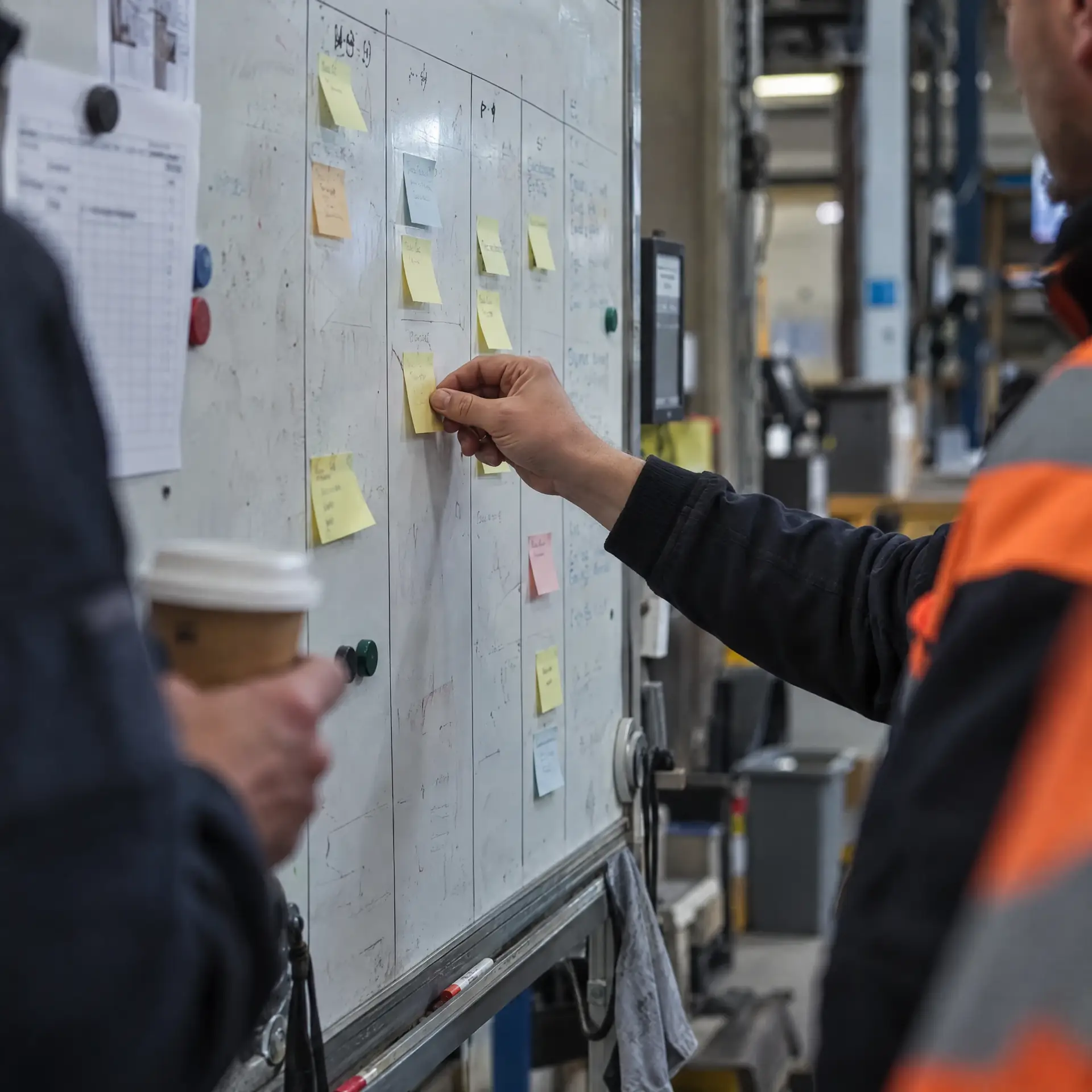
Improvements only last when employees can actually work with them. Make problems visible, test solutions, and embed what works into the daily rhythm of your operations.
An improvement action initially yields results, but a few months later everyone is back to working the old way. The instructions are unclear, new employees are unaware of the agreement, and no one checks whether the effect persists. Continuous improvement prevents this not by constantly launching new projects, but by making investigating, testing, and securing part of daily work.
This final article in 'Building a Strong Supply Chain' connects the previous topics: goals, reliable information, appropriate technology, and collaboration. Lean offers principles and tools to reduce waste and deliver more value to the customer, while respecting the people performing the work.
1. Make one recurring problem concrete
Do not start with 'we need to work more efficiently', but with an observable deviation. Which orders are being delayed? Which task requires rework? Investigate together with employees how the process actually unfolds. For example, use a process overview or a root cause analysis, but treat ideas about causes initially as hypotheses that you need to test.
2. Test an improvement with PDCA
PDCA stands for Plan, Do, Check, and Act. You define the problem and the expected improvement, carry out a scoped trial, evaluate the result, and decide what to standardize or adjust. Clarify in advance who is involved, what you are measuring, and what risks the trial carries. Small improvements are valuable, but some problems also require a major redesign.
Illustrative example: recurring picking errors
Suppose that two very similar items are regularly mixed up. Observation indicates that their locations are right next to each other and the identification does not provide sufficient distinction. The team can test an alternative location layout and clearer identification. This is an illustrative example, not a proven customer result.
Afterward, assess both errors and pick time across a sufficient number of comparable orders. A different item mix or an extra final check can distort the picture. Only when the effect is sufficiently clear do you standardize the new working method and assess whether comparable locations require the same attention.
3. Connect daily signals to business goals
Teams need information they can act upon themselves. For instance, picking errors and waiting times can explain why complete and on-time delivery is under pressure. Choose appropriate indicators per level and make their correlation clear. There is no mandatory Lean classification into KPIs, PIs, and 'Handling Indicators'; usability for your own process is leading.
Briefly discuss deviations during a daily stand-up and schedule more in-depth investigation separately. Link every action to an owner and a follow-up moment. In addition to speed, monitor safety, quality, and workload, ensuring that local improvement does not come at the expense of people or the next process step.
4. Secure the standard and provide room to learn
A standard describes the agreed working method at this moment and serves as the starting point for subsequent improvement. Make it understandable, train employees, and check together whether the agreement remains feasible. Also involve new colleagues and other shifts. Freedom to improve works within clear boundaries for safety, quality, and authority.
Managers make time available, help remove obstacles, and ask for root causes instead of placing blame. Technology can support logging and alerting, but it does not replace this ownership. Even in a mature continuous improvement culture, coaching, prioritization, and occasionally targeted projects remain necessary.
Your first step
Choose one recurring disruption and go through a complete improvement cycle with the team. Not just devising a measure, but also testing its effect, establishing agreements, and checking again later. This is how the foundation from this series becomes visible in daily operations. N&J Connect supports this with practical Lean training and coaching on the shop floor.